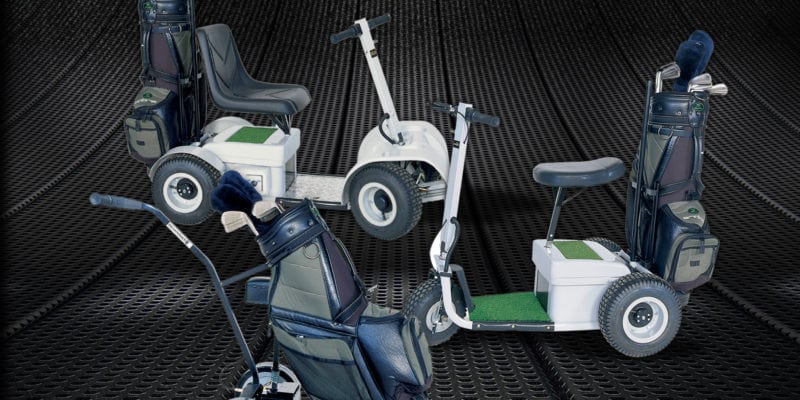
I think we can all agree that golf buggies are an extremely effective way of reducing wear and tear on your body, and can give older, injured or less mobile golfers greater longevity in the game. But if you’re considering a golf buggy for the first time, you’re probably tossing up between getting a walker golf buggy or a ride-on one. And this can be a hard decision, as there are pros and cons to each choice. We’ll have a look at the case for each – and which type of golfer each choice might be best for. Let’s tee off and compare.
The case for the motorised walker golf buggy
Walker Pros
• Still gets you some exercise. You’re walking the course, so your legs don’t get jealous (or flabby).
• Compact and nimble. Walkers often weigh less, take up less room, and are easier to navigate through tight fairway sections or around bunkers.
• Lower cost. Because they are simpler machines, they tend to have lower price tags and lower maintenance overhead.
• Minimal footprint. Less impact on the turf, especially in wet conditions or on delicate greens approaches.
• Ease of use. Most walkers are plug and play — just power up and guide it. No need to learn steering angles or brakes (well, apart from what your legs do).
Walker Cons
• Still work (a little). If you’re looking for zero effort, walking and managing a walker is more work than sitting down.
• Less storage, comfort, and shelter. Some ride-on buggies come with shade, seats, extra space, and creature comforts that walkers can’t match.
• Handling steep terrain. On very hilly courses, walkers may struggle or require more torque, battery, or control finesse.
So, if you enjoy walking (or at least tolerate it), want a lighter option, and don’t mind a bit of physical involvement, a walker might suit you just fine.
The case for the ride-on golf buggy
Ride-on Pros
- Pure comfort. Sit back, relax, perhaps even hum “Take Me Home, Country Roads” while cruising between holes.
- Less fatigue. For those with sore knees, bad backs, or “those days when your legs just can’t” — ride-ons are lifesavers.
- Higher capacity. You can carry more gear, hydration, even a picnic if your golf club allows it.
- Better for hilly courses. Ride-ons generally have stronger motors, more torque, and better stability over uneven terrain.
- Faster rounds. You’ll zip between shots faster (assuming you resist the temptation to stop at every scenic view).
Ride-on Cons
- Bigger, heavier, sometimes more costly. You’ll pay more for all that luxury and power.
- Possible access limitations. Some clubs or courses restrict ride‑ons in wet or sensitive areas.
- Parking, transport hassles. Ride-ons may require more space, stronger car carriers, or heavier lifting.
So, walker or ride-on? The verdict (spoiler: it depends)
Whether you choose a walker or ride on might depend on a wide variety of factors, including your fitness level, any injuries or health conditions, your usual local weather conditions or the structure of your local course. For example, if you live in an area that experience a great deal of heat and humidity, a ride-on golf buggy would be the best choice to keep you fresher and promote a cooling air flow. If your climate is more moderate, you can get away with a motorised walker more easily. Or if your local course features exceptional distances between holes, or Everest-like hills, you’re better off going for a ride-on buggy. Flatter and shorter courses make a walker buggy a more feasible choice.
Choose a walker golf buggy if:
• You enjoy walking
• You are capable of walking the course, but just need a little assistance getting your clubs around
• You want to retain the health benefits of walking, as walkers still burn a significant number of calories when pushing or pulling a golf buggy
• You want sharper mental focus, as certain studies correlate walking the course with better focus during a round.
• You prefer minimal gear and fuss
• You want a lower purchase and maintenance cost
Choose a ride-on golf buggy if:
• You prefer (or need) to conserve your energy for the game, rather than walking long distances
• You have sustained an injury or have a physical limitation that makes walking the course hard or even impossible
• You have a medical condition that prevents you walking long distances
• You prefer to play your round a little quicker
• You regularly play long, hilly course
• You want maximum comfort and speed
In truth, many golfers start with a walker and later “upgrade” to a ride on as their circumstances or preferences change. If you’re finding it hard to choose, test drive both types and see how you feel after you’ve tried each one. As well, check your local course rules, as some courses restrict where ride-ons can go, especially on soft or wet fairways. You’ll also need to consider how you’ll transport your buggy to the course (although with Parmaker, this is not a problem for either type, as both types pack up and fold down small and can be easily transported in the boot of your car or using a special car carrier).
If you relish walking, love simplicity and don’t demand all the bells and whistles, a Parmaker walker might be your perfect fairway companion. But if comfort, speed, and letting your legs nap while you play are priorities, the Parmaker ride-on range delivers with class, power and pure golfing joy.
Whichever side of the (golf buggy) fence you land on, Parmaker has your back – because we believe every golfer deserves a dependable partner on the course. We’ve designed both walkers and ride-ons to be strong, durable and easy to use. Our walker models include the Scout and Scout SE series, while our ride on offerings include the Spirit and Explorer lines.
Want to see the full range and pick your perfect match? Check out Parmaker’s golf buggies here.